THE COMPLETE GUIDE Stand Up Pouches (Standy Pouch / Doypack)
| 16 Mar 2026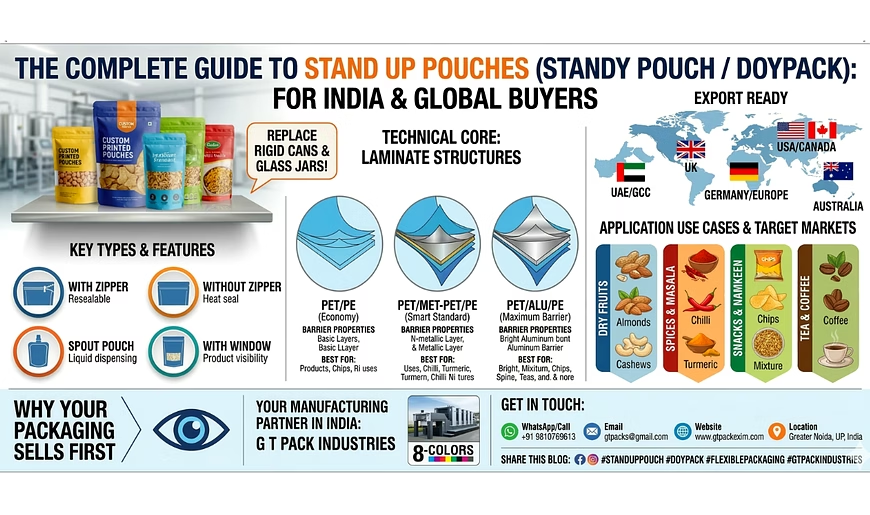
G T PACK INDUSTRIES
THE COMPLETE GUIDE
Stand Up Pouches (Standy Pouch / Doypack)
Laminate Structures · Types · Sizes · Applications · Export Guide
For Food Manufacturers, Brand Owners & Export Buyers in India and Globally
Why Your Product's Packaging Is Selling Before Your Product Does
Walk into any kirana store, modern retail outlet, or browse through any e-commerce platform in India today — and you will notice one thing. The products that catch your eye first are not always the best products. They are the best packaged ones.
In today's competitive market, packaging is not just a container. It is your first salesperson. It communicates quality, builds trust, and triggers a purchase decision — often before the buyer even reads the label. And among all flexible packaging formats available in India today, one format consistently dominates shelf space, social media feeds, and export shipments alike.
The Stand Up Pouch — locally known as the Standy Pouch, and internationally as the Doypack — has become the preferred packaging choice for food brands, FMCG companies, spice manufacturers, dry fruit exporters, and pharmaceutical companies across India and globally.
But choosing the wrong stand up pouch — the wrong laminate, the wrong size, the wrong structure — can cost you more than money. It can cost you customers, shelf life, and brand credibility.
This guide covers everything you need to know. From laminate structures to application-specific recommendations, from sizes to export standards — this is the most complete guide to stand up pouches written from a manufacturer's perspective, for Indian and global buyers.
What is a Stand Up Pouch? (Standy Pouch / Doypack)
A Stand Up Pouch — called Standy Pouch in the Indian packaging trade — is a flexible packaging format made from multi-layer laminated films that is designed with a bottom gusset, which allows the pouch to stand upright on retail shelves without any additional support.
Internationally, this format is widely known as a Doypack, a name derived from the French inventors Louis Doyen and Ets Doyen who patented the original design in 1963. Whether you call it a stand up pouch, standy pouch, standy bag, or doypack — the format is the same: a self-standing, flexible, customizable packaging solution that has replaced rigid cans, glass jars, and cardboard boxes in a wide range of industries.
Structure: A standard stand up pouch consists of 2 to 4 layers of laminated films, each layer serving a specific purpose — outer printing layer, barrier layer, sealing layer — bonded together using solvent-based lamination or dry lamination processes.
Distinct Feature: The bottom gusset — a folded inward section at the base — expands when filled, allowing the pouch to stand on its own. This is what separates a stand up pouch from a flat pouch or a pillow pouch.
Why Are Brands Across India Shifting to Stand Up Pouches?
The shift from traditional packaging formats — tin cans, glass bottles, cardboard boxes, flat sachets — to stand up pouches is one of the biggest packaging industry trends of the last decade. There are clear, practical reasons behind this shift.
1. Superior Shelf Visibility
Stand up pouches occupy vertical shelf space, placing your brand's printed design at eye level. Unlike flat packets that lie on a shelf, a standy pouch stands tall and faces the customer directly. In modern retail — where a consumer makes a buying decision in under 3 seconds — this visibility is a significant competitive advantage.
2. Barrier Performance and Longer Shelf Life
With the right laminate structure — particularly with a metallised layer (MET-PET) or an aluminium foil (ALU) barrier — a stand up pouch protects contents from moisture, oxygen, light, and aroma loss. For products like dry fruits, spices, coffee, namkeen, and pharmaceuticals, this translates directly into longer shelf life without chemical preservatives.
3. Cost Efficiency Over Rigid Packaging
Compared to tin containers, glass jars, or rigid plastic bottles, stand up pouches consume significantly less raw material, weigh less, and take up less space during transport and storage. This reduces logistics costs, especially for export shipments where dimensional weight matters.
4. Consumer Convenience
Stand up pouches with zipper closures allow consumers to reseal and store products easily. Tear notches enable clean, easy opening. Spout closures make liquid or semi-liquid dispensing mess-free. These features directly influence repeat purchase behaviour.
5. Customisable Branding
With 6 to 8-colour rotogravure printing, stand up pouches can carry high-definition brand designs, product photography, regulatory information, QR codes, and multilingual text — all on a single package. For brand owners, this is a direct investment in brand identity.
6. Export Readiness
Stand up pouches meet international food safety and packaging standards. For Indian exporters targeting markets like UAE, Saudi Arabia, UK, Germany, and the USA, the doypack format is already the globally recognised, preferred packaging format for food, spices, and dry fruits.
Types of Stand Up Pouches — Complete Breakdown
Not all stand up pouches are the same. Depending on your product, your target market, and your branding requirements, different variants offer different functional advantages. Here is a complete breakdown of all stand up pouch types manufactured at G T Pack Industries.
Pouch Type | Key Feature | Best For |
Stand Up Pouch with Zipper | Resealable zipper closure at top | Dry fruits, snacks, pulses, coffee, tea |
Stand Up Pouch without Zipper | Heat seal only, single-use | Spices, rice, sugar, powders |
Stand Up Spout Pouch | Spout for liquid dispensing | Juices, oils, sauces, liquid food |
Stand Up Pouch with Window | Transparent window for product visibility | Dry fruits, cookies, candies, pet food |
Kraft Paper Stand Up Pouch | Brown kraft paper outer layer | Organic products, premium food brands |
Matte Finish Stand Up Pouch | Matte outer printing surface | Premium FMCG, nutraceuticals, pharma |
Glossy Stand Up Pouch | High-gloss printed surface | Retail foods, branded FMCG products |
Foil Stand Up Pouch (ALU) | Aluminium foil barrier layer | High barrier food, pharma, export |
Stand Up Vacuum Pouch | Compatible with vacuum sealing | Meat, fish, cheese, long shelf life products |
Laminate Structures — The Technical Core
This is the section most stand up pouch manufacturers in India do not talk about openly — because understanding laminate structures is what separates an informed buyer from a confused one. At G T Pack Industries, we believe buyers deserve complete technical knowledge before making a decision.
A stand up pouch is only as good as its laminate structure. The laminate determines barrier performance, seal strength, printability, puncture resistance, and ultimately — the shelf life of your product. Here is a complete guide to all major laminate structures used in stand up pouches.
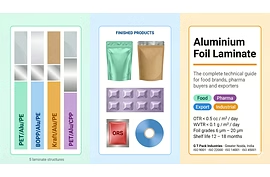
Structure 1: PET / PE — General Purpose, Economy Grade
Full Form: Polyester (Biaxially Oriented) / Polyethylene
Barrier Properties: Basic moisture barrier. No oxygen or aroma protection.
Best For: Products with short shelf life or products that are not sensitive to oxygen — salt, sugar, low-value grains, industrial powders.
Printing: Reverse printing on the PET layer gives high-definition results.
Limitation: Not recommended for dry fruits, spices, coffee, or any product requiring oxygen or aroma barrier. Product will go stale faster.
Structure 2: PET / MET-PET / PE — The Smart Standard (Recommended for Most Food Products)
Full Form: Polyester / Metallised Polyester / Polyethylene
Barrier Properties: High moisture barrier. Good oxygen barrier. Excellent aroma retention.
Best For: Dry fruits, namkeen, snacks, biscuits, spices, masala, tea, coffee, pulses, atta, rice — essentially the majority of Indian food products.
Printing: Reverse printing on outer PET. Metallised layer gives a premium silver finish to the pouch interior.
Why It's the Industry Standard: This structure offers the best balance of cost and performance for mainstream food packaging. It protects products for 6 to 12 months under normal storage conditions.
Export Suitability: Accepted in UAE, Saudi Arabia, and GCC markets for food packaging.
Structure 3: PET / ALU / PE — Maximum Barrier, Export Grade
Full Form: Polyester / Aluminium Foil / Polyethylene
Barrier Properties: Highest moisture barrier. Maximum oxygen barrier. Complete light protection. Strong aroma lock.
Best For: Premium dry fruits (kesar, pistachios), high-value spices (saffron, cardamom), pharmaceutical powders, medical devices, retort food products, export shipments to Europe and North America.
Printing: Reverse printing on outer PET layer. Interior foil gives a silver metallic appearance.
Why Choose This: When product shelf life, export compliance, or brand premium positioning is the top priority, PET/ALU/PE is non-negotiable.
Limitation: Higher cost than PET/MET-PET/PE, and cannot be used in retort applications unless combined with appropriate sealant layers.
Structure 4: BOPP / CPP — For Dry, Non-Sensitive Products
Full Form: Biaxially Oriented Polypropylene / Cast Polypropylene
Barrier Properties: Basic moisture barrier. Transparent. Food-safe.
Best For: Bakery items, biscuits, light snacks, dry products that do not require oxygen barrier. Also used in confectionery packaging.
Advantage: Good clarity and sealability at lower cost.
Structure 5: PA / PE — For Vacuum and Meat Applications
Full Form: Polyamide (Nylon) / Polyethylene
Barrier Properties: Excellent oxygen barrier. High puncture resistance. Suitable for vacuum sealing.
Best For: Vacuum packed meat, fish, cheese, processed food that requires oxygen exclusion.
G T Pack Industries Recommendation For the majority of Indian food product manufacturers — dry fruits, spices, namkeen, tea, coffee, pulses — the PET / MET-PET / PE structure provides the best balance of protection, printability, and cost. For export or premium products, upgrade to PET / ALU / PE. When in doubt, contact us and we will recommend the right structure for your specific product. |
Application-Specific Use Cases — Which Pouch for Which Product?
One of the most common questions buyers ask is — 'Which stand up pouch should I use for my product?' The answer depends on your product category, shelf life requirement, storage conditions, and target market. Here is a detailed, product-specific guide.
Dry Fruits Packaging — Almonds, Cashews, Pistachios, Raisins, Walnuts
Dry fruits are highly sensitive to moisture and oxygen. Any compromise in barrier performance results in loss of crunch, change in colour, and reduced shelf life — all of which directly impact customer satisfaction and brand reputation.
• Recommended Structure: PET / MET-PET / PE for domestic market | PET / ALU / PE for export
• Recommended Closure: Zipper (resealable) — essential for consumer convenience
• Finish: Matte or glossy depending on brand positioning
• Size Range: 100g to 1 kg pouches most common in Indian retail | 250g to 500g for export gifting
• Export Markets: UAE, Saudi Arabia, UK, USA, Canada — all require good barrier and professional printing
Spice and Masala Packaging — Chilli, Turmeric, Coriander, Garam Masala
Spices are highly aromatic and prone to aroma loss and colour fading when exposed to light and oxygen. Packaging for spices needs to retain colour vibrancy, lock in natural aroma, and prevent clumping due to moisture absorption.
• Recommended Structure: PET / MET-PET / PE (standard) | PET / ALU / PE for premium/export
• Recommended Closure: Heat seal with tear notch — most common | Zipper for refill packs
• Printing: 8-colour rotogravure for vibrant red/yellow spice brand designs
• Size Range: 50g, 100g, 200g, 500g, 1 kg most common
Snacks and Namkeen Packaging — Bhujia, Chips, Mixture, Popcorn
Namkeen and snack products require a balance between barrier protection (to prevent staleness) and cost efficiency (since snacks are sold at competitive price points). The packaging also needs to withstand handling and transport without puncturing.
• Recommended Structure: PET / MET-PET / PE
• Recommended Closure: Heat seal with tear notch
• Finish: Glossy with high-impact colourful printing to attract retail buyers
• Size Range: 30g, 50g, 100g, 200g, 500g
Tea and Coffee Packaging
Tea and coffee are particularly sensitive to oxygen and moisture, which degrade flavour compounds rapidly. For coffee, CO2 degassing after roasting is an additional consideration — which makes a degassing valve a useful add-on for freshly roasted coffee.
• Recommended Structure: PET / MET-PET / PE | PET / ALU / PE for specialty coffee and premium teas
• Optional Add-ons: Degassing valve for roasted coffee, zipper for loose tea
• Size Range: 50g, 100g, 250g, 500g, 1 kg
Pulses and Grains — Dal, Rajma, Chana, Rice
Pulses and grains are relatively less sensitive than spices or dry fruits, but still benefit from moisture protection to prevent weevil infestation and quality degradation. For retail branding, printed pouches give a significant advantage over plain woven bags.
• Recommended Structure: PET / PE (economy) | PET / MET-PET / PE (branded retail)
• Size Range: 500g, 1 kg, 2 kg, 5 kg
Pharmaceutical Powder and Healthcare Products
Pharmaceutical applications require strict compliance with food and drug safety standards. Pouches used for pharmaceutical powders, sachets, nutraceutical products, and health supplements must have excellent barrier properties and be manufactured under controlled hygienic conditions.
• Recommended Structure: PET / ALU / PE | Foil-based laminates
• Compliance: Food-grade and pharmaceutical-grade raw materials
• Size Range: 5g to 500g sachets and pouches
Standard Sizes and Weight Capacities — What Size Do You Need?
Stand up pouches are manufactured in a wide range of sizes to accommodate products from 30 grams to 5 kilograms. The right size depends on your product's density, your retail price point, and your consumer usage pattern.
Product Weight | Pouch Dimensions (approx.) | Common Products | Recommended Structure |
50g – 100g | 10 x 16 cm | Spices, masala sachets | PET/MET-PET/PE |
150g – 250g | 12 x 19 cm | Snacks, tea, spices | PET/MET-PET/PE |
300g – 500g | 15 x 22 cm | Dry fruits, namkeen, coffee | PET/MET-PET/PE or PET/ALU/PE |
500g – 1 kg | 18 x 26 cm | Pulses, mixed dry fruits, atta | PET/MET-PET/PE |
1 kg – 2 kg | 22 x 30 cm | Rice, flour, bulk spices | PET/PE or PET/MET-PET/PE |
2 kg – 5 kg | 26 x 36 cm | Bulk pulses, institutional food | PET/PE heavy gauge |
Note: All dimensions are approximate. Custom sizes are manufactured as per buyer specification at G T Pack Industries.
Printing and Branding — Where Your Identity Lives
In flexible packaging, printing is where a manufacturer's product becomes a brand's identity. At G T Pack Industries, we operate 8-colour and 6-colour rotogravure printing machines — which is the gold standard for flexible packaging print quality in India.
Why Rotogravure Printing?
Rotogravure (commonly called roto printing or gravure printing) uses engraved cylinders to transfer ink onto the film. It produces sharper colour reproduction, more consistent ink density, and far better print quality than digital or flexographic printing — especially for long print runs above 5,000 to 10,000 metres.
• Up to 8 colours in a single pass
• Consistent quality across the entire print run — critical for brand standardisation
• Ideal for products with intricate designs, photographic elements, or gradient colour schemes
• Reverse printing (inside of the outer film) protects ink from rubbing off in transit and handling
Print Finishes Available
• Glossy Finish: Vibrant, high-impact appearance. Best for consumer retail products.
• Matte Finish: Premium, sophisticated look. Preferred by nutraceutical, organic, and premium food brands.
• Matte with Spot Gloss: Combination finish — matte background with selective gloss highlights for brand elements or product photos. Premium positioning.
What Can Be Printed?
• Brand name and logo
• Product photography and ingredient visuals
• Regulatory information — FSSAI number, batch code, MRP, expiry date
• Barcode and QR code
• Multilingual text for export markets
• Nutritional information panel
Export Suitability — Doypacks for Global Markets
India is one of the world's largest exporters of spices, dry fruits, rice, and processed food products. The packaging that protects and presents these products in international markets plays a critical role in brand perception and compliance with importing country regulations.
At G T Pack Industries, we manufacture export-grade stand up pouches — internationally known as doypacks — that meet the requirements of buyers in UAE, Saudi Arabia, UK, Germany, Netherlands, USA, Canada, and Australia.
What Makes a Stand Up Pouch Export-Ready?
• High-barrier laminate structure (PET/MET-PET/PE or PET/ALU/PE) to withstand long transit times and varied climate conditions
• Food-grade raw materials compliant with international food contact material regulations
• Strong heat seal integrity to prevent leakage and contamination in transit
• Accurate multilingual printing including English, Arabic, German or other target market languages
• Correct barrier specifications for the specific product and destination country requirements
• Appropriate pack sizes — international markets often prefer 100g, 250g, 500g formats for direct consumer sale